

Online EMDR Therapy: Does It Work? | Creating Change
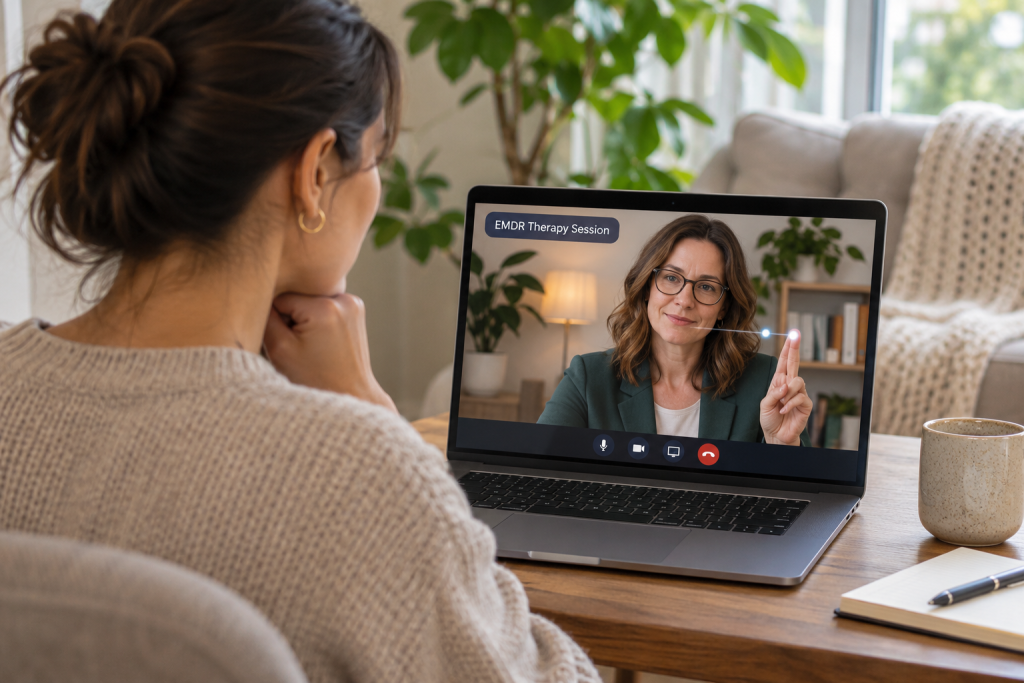
Can EMDR Therapy Work Online? Why Telehealth EMDR Is a Doorway to Healing
By Rebecca Deane, Director & Principal Clinical Psychologist, Creating Change Psychology & Counselling
When telehealth first became part of everyday psychology, I’ll admit I had questions. Could the connection that makes therapy work really carry through a screen? And could something as personal as trauma work feel safe when we weren’t in the same room?
Several years and many hundreds of sessions later, my answer is a confident yes. For some people, online EMDR isn’t a second-best option. It’s what finally makes trauma therapy possible.
What is EMDR?
Eye Movement Desensitisation and Reprocessing (EMDR) is a structured, evidence-based therapy for trauma. While you briefly focus on a distressing memory, you also follow bilateral stimulation, such as eye movements or alternating taps. This helps the brain reprocess the memory, so it feels less vivid and less upsetting, and loses its grip on the present.
EMDR is recommended in the Australian guidelines for treating post-traumatic stress disorder (PTSD), alongside trauma-focused CBT.
What does the research say about online EMDR?
The evidence is encouraging.
- Video therapy works as well as in-person therapy. A 2021 meta-analysis found therapy delivered by video was no less effective than face-to-face therapy. The strongest results were for anxiety, depression and PTSD (Fernandez et al., 2021).
- The relationship holds up online. A review of 23 studies found clients consistently built a strong therapeutic relationship with their therapist over video (Simpson & Reid, 2014).
- Online EMDR reduces symptoms. A UK evaluation of 93 clients who received EMDR remotely during the pandemic found statistically significant and clinically meaningful improvements for both adults and young people (McGowan et al., 2021).
Research into online EMDR is still growing. An early systematic review called for more controlled trials (Lenferink et al., 2020). But the findings so far match what I see in my own work: people do the work, and they get better.
Five reasons telehealth EMDR can work so well
1. You feel safer in your own space
Many people who have experienced trauma find it hard to feel “seen” or exposed, especially in an unfamiliar room with someone they’ve only just met.
Picture someone who was assaulted on her way home from work. Even the drive to a clinic, the waiting room and the closed door can set off her alarm system before we’ve said a word. At home, on her own couch with a cup of tea and her dog beside her, her body is already calmer. That sense of safety gives her more room to do the work.
2. You take an active role in your healing
In online EMDR, you often provide your own bilateral stimulation. That might mean following a moving dot on screen, or gently tapping your shoulders with your arms crossed (the “butterfly hug”).
I often notice that clients who tap for themselves feel more in charge of their recovery. They’re not having something done to them. They’re using their own body to calm their nervous system, and that’s a skill they can take with them long after therapy ends.
3. Help reaches people who couldn’t otherwise get it
Trauma rarely arrives alone. It often comes with other hurdles, such as disability, chronic illness, caring for young children or ageing parents, living a long way from services, long work hours or tight finances.
Think of a dad of three in a rural town, hours from the nearest EMDR-trained psychologist. Or a woman with chronic pain who can’t sit through a long car trip. Telehealth means she can have evidence-based trauma treatment from her own home.
4. Your therapy stays consistent
Trauma therapy works best when it’s regular. Missing sessions can stall progress and make it harder to get going again.
With telehealth, sessions can continue when you’re travelling for work, recovering from a cold, without a babysitter, or dealing with the school holidays. That continuity helps keep your progress moving.
5. You stay in control of your environment
Telehealth gives you choices that a therapy room doesn’t always offer. If you feel overwhelmed, you can look away from the camera, turn your video off for a moment, wrap yourself in a favourite blanket or dim the lights.
These small choices matter. Trauma often involves losing control, and therapy that respects your control is trauma-informed by design.
Is online EMDR right for me?
Online EMDR can suit many adults and young people. Your psychologist will talk with you about whether it’s the right fit, taking into account:
- whether you have a private, quiet space where you won’t be interrupted
- a reliable internet connection and a laptop or tablet (larger screens are better than phones)
- your safety plan: we’ll agree in advance what happens if you feel distressed or the connection drops
- your preference: some people still prefer in person, and that’s completely okay
For some people, a mix works best, with in-person sessions for the most intense processing and telehealth in between.
Taking the first step
When someone finally reaches out for trauma therapy, it has often taken them years to get there. I never want travel, time or circumstances to be the reason they can’t continue.
Telehealth doesn’t just make EMDR possible. For many people, it makes trauma therapy more accessible, more empowering and easier to keep going with. For some, it’s the doorway to healing they thought they’d never walk through.
At Creating Change, our EMDR-trained psychologists offer sessions in person in Bella Vista and by telehealth across Australia. There’s no waitlist, appointments run until 9pm and on Saturdays, and Medicare rebates are available with a Mental Health Treatment Plan from your GP.
Explore EMDR & Trauma Support
Find out more about how we can help
If you are in crisis or immediate danger, call 000 or Lifeline on 13 11 14.